
Lorica
in the new age
Dr. Ben Reinhard

In the world of Christian publishing, canny and considerate writers tend to pay attention to the progress of the liturgical year: they have their Advent reflections ready before the first candle is lit, and their Easter columns prepared well before Good Friday. Such preparation is the norm for good reasons. It is a gracious and good thing to give readers something to reflect on as they make their way through the feast or fast, and in any case timely articles are more likely to draw a larger audience. Such prevision is not always possible in the spiritual life, however. Sometimes a saint takes you by surprise: perhaps gently, like the smell of fresh-cut grass borne on an unexpected breeze; perhaps violently, like a terrier seizing on a rat. Such unforeseen irruptions deserve their reflection, too.
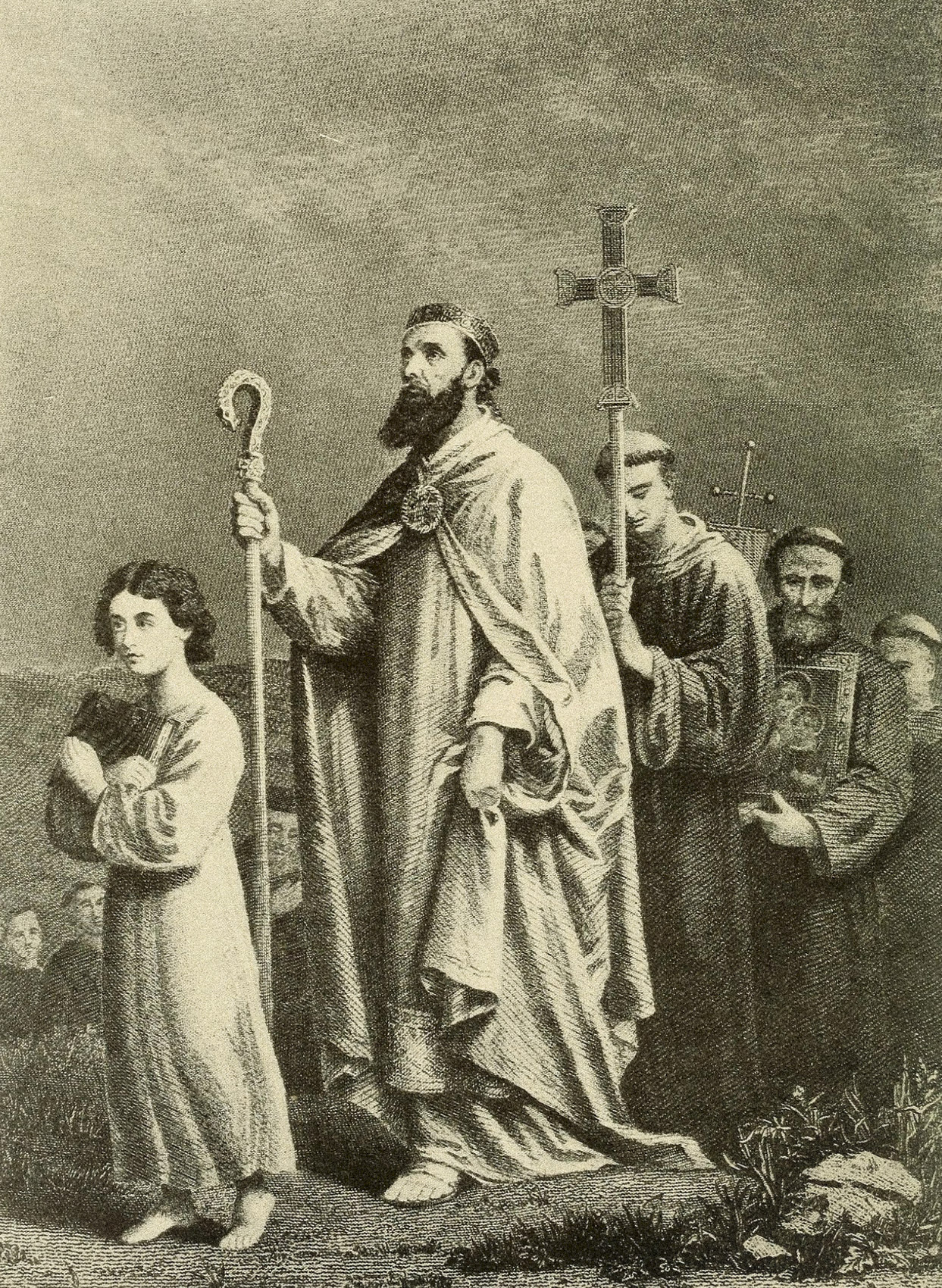
And so it was I found myself captured this March 17 by that mighty prayer, the Lorica of St. Patrick. According to the traditional account, the saint first recited it as he and his monks prepared to walk the dangerous road to spread the faith in Tara; the murderers lying in ambush saw only deer as Patrick and his band passed by. As I prayed it with my family in the morning of Saint Patrick’s Day — and again when I prayed it with my students that afternoon — I was caught by an inescapable thought: This prayer is more important now than it has been at any point in the past thousand years. It may even be, of all the prayers in the Church’s rich treasury, one of the most important for Christians in the years to come.
A bold claim, of course, especially for so unusual a prayer. Patrick’s Lorica – that is, his hauberk or corselet — is (as its name suggests) a prayer of protection; as one of my colleagues pointed out, one might almost call it a charm or an incantation. The prayer is moreover the product of a world very different from the safely predictable mechanistic universe most moderns, Christians included, believe they inhabit. For centuries, religious life has tended towards cleanness and compartmentalization and control: religion is tolerated, but does not much impinge on daily affairs. Saint Patrick’s world is . . . other. It is a world of demons, witches, and spellcraft: one in which even a saint like Patrick can fear the malefic activities of wizards and smiths. As my students rightly observed, the saint knows nothing at all of what the Canadian Philosopher Charles Taylor calls the “buffered self” of secular modernity — that is, the “secure inner mental realm” of the sovereign individual. This buffered self is invulnerable to external influences, whether spiritual, demonic, or cosmic. But this is not the world of Patrick. No: he inhabits an enchanted world, and it is terrifying, full (as the Lorica says) of “cruel merciless powers” that can invade the very soul. Incantations, spells, and the black laws of pagandom loom as very real threats.

This buffered self is invulnerable to external influences, whether spiritual, demonic, or cosmic. But this is not the world of Patrick.
And herein lies the prayer’s special relevance for the twenty-first century. However alien Patrick’s world is from the brightly lit and rationalistic world most of us were raised in, it looks uncomfortably like the world that is just now aborning. Anyone who has experienced the listless unquiet brought on by an hour or two scrolling a smartphone or playing a video game — still more anyone who has been sucked into the unreal worlds of internet “community” or sycophantic chatbots — will know that their soul is not quite so sovereign or impregnable as secular Enlightenment would have us believe. The recent surge of anti-Christian and anti-human spiritualities — old ones such as witchcraft and satanism, new ones such as transhumanism and Ufology — should remind us that, even if the Church is not interested in returning to a world of pre-modern enchantment, her enemies most certainly are. And this is to say nothing of the rising powers, public and private, capitalistic and communistic alike, that seek unlimited control over the minds as well as the bodies of their unhappy subjects.
All this is sufficient to demonstrate that “the fears, anxieties, even terrors” of Professor Taylor’s old enchanted world are not so far gone as they might have seemed even a few years ago: reports of their death were greatly exaggerated. At best, they slept uneasily. In this context, Patrick’s prayer “against every knowledge that corrupts man’s body and soul” takes on special force. I do not know, wholly, what soul-destroying knowledge looked like in the druidic Ireland of Saint Patrick. I have some inkling of what it might look like in the emergent technocracy.
For all the perils of Patrick’s world, his prayer is the furthest thing from a counsel of despair: its tone is militant, exultant, triumphant. For Saint Patrick is not alone in his battle against the dark enchantments of the world — and neither are we. The Lorica asserts and makes real the Christian’s place in the order of “the Creator of creation.” The saint is equally at home invoking the mysteries of the Trinity and the Incarnation, the virtues of the Church Triumphant, and the powers of Creation itself, summoning “all these powers” between him and evil. Thus the love of the Cherubim and obedience of angels belong to the saint — as do depth of the sea, speed of lightning, and firmness of the rock. He stands on the side of all that is real and the holy against the raging void of hell. But above all else, Patrick finds his defense in the Crucified:
Christ with me, Christ before me, Christ behind me,
Christ in me, Christ beneath me, Christ above me,
Christ on my right, Christ on my left,
Christ when I lie down, Christ when I sit down.
In this, he shows himself a good student of Saint Paul: like his great missionary predecessor, he wields weapons “mighty to God unto the pulling down of fortifications, destroying counsels, And every height that exhalteth itself against the knowledge of God, and bringing into captivity every understanding unto the obedience of Christ.” The early centuries of the Church took passages like this in deadly earnest; the time has come for modern Christians to relearn the lesson.
With all this in mind, I reflect that, perhaps, the late and unseasonable composition should not trouble me. The prayer may have special relevance on March 17, but Saint Patrick’s Lorica should not be an affected, once-a-year eccentricity on the level of corned beef, leprechaun hats, and ghastly green beer. It is a prayer for the ages — and, particularly, a prayer for our age.