

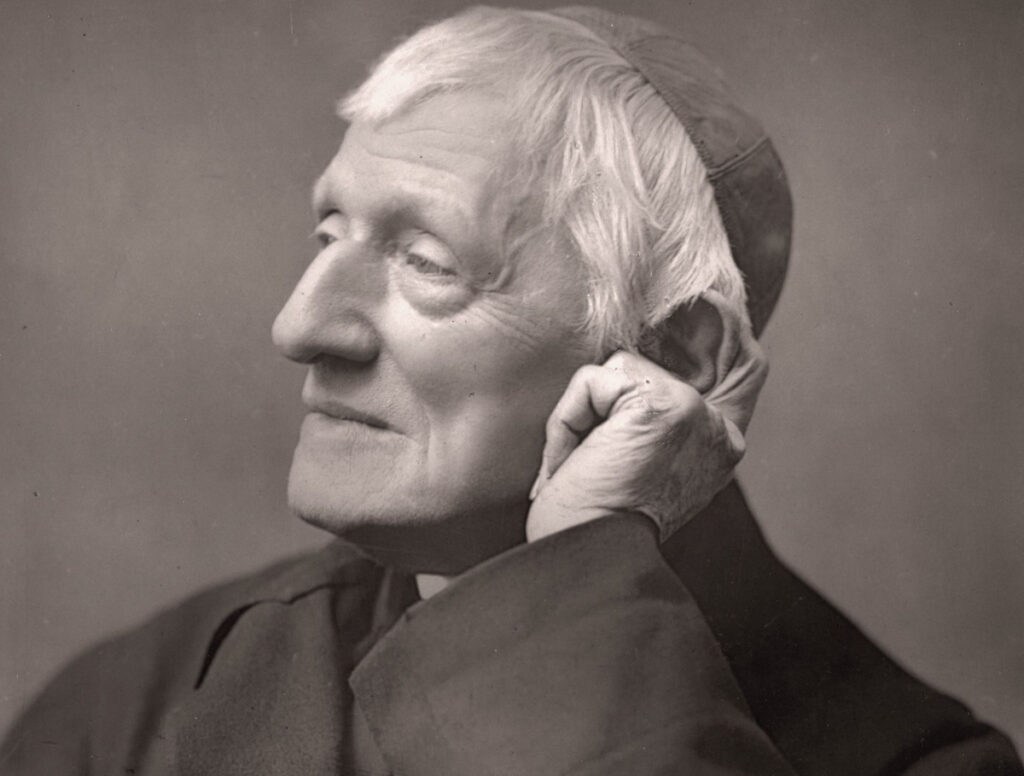
John Henry Newman,
Local Hero

Dr. Christopher John Lane


As your teeth pass through the chocolate shell and reach the gooey “yolk” of a Cadbury Creme Egg on any given Easter, realize that you have John Henry Newman to thank for your confectionary celebration of the Resurrection. Sort of.
Like the two other founding families among the “big three” Victorian-era British confectioners, the Cadburys were Quakers. These religious and philanthropic industrialists sought to combine profit-making with love for the workers at their factory south of Birmingham, England. In 1889, however, their beneficent intentions had sparked a labor dispute that required Cardinal Newman, the founder of the local Oratorian community of priests, to mediate. A group of young female Catholic workers had refused to attend the factory’s daily morning Bible commentary and prayer service, the details of which clashed with Catholic teaching. The eighty-eight-year-old Cardinal Newman was driven out to confer with Richard and George Cadbury, who hoped that the scholarly, irenic shepherd of souls would convince the girls to participate. He instead supported the girls’ position and that of their parish priest, emphasizing the place of conscience, a principle cherished by both the Cardinal and the two Quakers. The brothers reported being “charmed by the loving Christian spirit with which he entered into the question.” On the way home, Cardinal Newman remarked, “If I can but do work such as that, I am happy and content to live on.” The Cadburys ultimately set aside a space for Catholic prayer during the time of the morning service.
The Cadburys of Cardinal Newman’s day were already pioneers in chocolate Easter eggs, and filled eggs would join the family repertoire in the 1920s. Perhaps the affair of the “Cadbury girls” was of small consequence in the history of the firm. It might have been amicably resolved without Newman, and the company might have gone on to give us modern-day Creme Eggs, regardless. Still, it matters that it was resolved in this way, through a friendly conversation among mutually respected neighbors who shared some core convictions while also diverging on fundamental life questions. It was certainly a large event in the lives of the young women who had staked their livelihoods on their consciences. And this witness of mutual charity was one more step in the journey of the remarkable Cadbury family, whose frequent contemplation was the query, “And who is my neighbor?”
For the Cadburys, answering that question required setting down roots, working good for particular people in a particular place, without sacrificing a wider vision. The brothers went on to build, alongside their factory, the model village of Bournville, which offered to workers healthful Arts and Crafts houses, sports fields, a large children’s playground, a swimming pool, schools, and shops, not to mention old-age pensions. Richard and George were known to call off the work day early for a cricket match or a country walk with their employees. The family focused its further philanthropy on the needs of their ever-expanding industrial city, building schools, hospitals, and parks while serving as leading members of the Birmingham Civic Society.
Cardinal Newman likewise embraced a rooted life, serving particular people in the particular industrial city of Birmingham. Moreover, an ethos of the local and real, over against the centralized and abstract, was a conscious theme of his writing.
John Henry Newman’s resume would seem to give him high cosmopolitan credentials: Born in London. Student of Trinity College, Oxford and then Fellow of Oriel College, Oxford. Lengthy Mediterranean trip at the age of thirty-one. A year-and-a-half in Rome for formation as a Catholic priest. Founding rector of the Catholic University of Ireland. Eventually a Cardinal of the Church of Rome. Editor of periodicals of national note. Author of dozens of volumes of published works. Dukes and a prime minister in his wider circle of friends. Correspondence reaching about 21,000 epistles.
Yet deep local loyalties began to become evident in Newman’s Oxford years of 1816 to 1846. He expressed his ideal, for instance, in his 1827 poem “Snapdragon,” which opens with the flower describing itself as humbly “rooted in the wall” of an Oxford college and ends with the flower satisfied with its place: “well might I / In College cloister live and die.” Father Newman confirmed in his 1864 Apologia that the snapdragon in Trinity’s walls had long symbolized to him his own expected “perpetual residence even unto death” at the university.
Newman had been no habitual visitor to the Continent, and his 1833 Mediterranean trip — about halfway through his Oxford days, with his dear friend and fellow Anglican priest Hurrell Froude and the latter’s father — confirmed his sense of purpose at home. To his sister Jemima he wrote that the Greek temple in ruins atop a hill at Egesta, Sicily had emerged from a people that “fixed its faith as a solitary witness on heights where it could not be hid.” Contrasting the ruins with a once-again “wild” landscape and a rude shepherd’s hut, he contemplated the inevitable disappointment of classical ambition. Neither the prideful men who built temple and theater, nor the cunning demons who lured men to honor them in those buildings, were lastingly satisfied. “Here it was that Nicias came,” he noted, on the tragic expedition that reignited the Peloponnesian War and led to the great Athenian general’s execution. Sicily’s contrasts — “so beautiful and so miserable” in both past and present — instilled in Newman an “irresistible love” that drew him to return there alone before going back to England, after he and his friends had stayed a time in Rome.
That return to Sicily, which brought him to death’s door with a fever, was one of the great turning points in his life. While in Rome, the Anglican clerics Newman and Hurrell Froude had very little substantive interaction with Roman Catholics. At the end of their second brief and cordial visit with the English Roman Catholic seminary head Monsignor Nicholas Wiseman (later Cardinal and Archbishop of Westminster), Newman declared, “We have a work to do in England.” Weeks later, recovered from his illness and “aching to get home,” he repeated to the servant who had cared for him, “I have a work to do in England.” The harrowing fever had enabled him, on the boat from Palermo to Marseilles, to write the verses (entitled “The Pillar of the Cloud”) that would become the hymn “Lead, Kindly Light.” For the remainder of his life, that poem’s vision of life as pilgrimage would temper, but not destroy, the longing for rootedness expressed in “Snapdragon.”
The “work to do in England,” what became the Oxford Movement, an effort to reclaim the more ancient traditions of the Church, commenced almost immediately. Despite that reform effort’s national character, it reflected Newman’s emphasis on the local and particular over the centralized and abstract. He and others held a driving conviction that God, not Crown or Parliament, had made the Church in England. More to the point, God had charged the local bishop with care and governance of the Church in each place, and hence Parliament had no right to interfere in Church affairs. On a more personal level, Newman always abided by what he saw as his bishop’s divinely ordained authority over him: “It was one of my special supports and safeguards against myself; I could not go very wrong while I had reason to believe that I was in no respect displeasing him.” Though sympathetic to some of the movement’s principles, Bishop Bagot of Oxford also was willing to question their positions and check their zeal as he saw need, and Newman steered his own actions accordingly. After leaving the Church of England, Newman always felt it a providence to have been given, in those tumultuous Oxford Movement years, a bishop who was “as kind-hearted and as considerate as he was noble,” one who “ever sympathized with me in my trials.”
One of most important collections of Newman’s published works in this period, Parochial and Plain Sermons, arose from his duties as vicar of the University Church of St Mary the Virgin. He aimed primarily at the parish (hence “parochial”) rather than at the university, and thus produced what the late Ian Ker, among the greatest of Newman scholars, called “the most potent spiritual force of the Oxford Movement” and “one of the great classics of Christian spirituality.” Newman called his living hearers to a more real Christian life, rather than a vague cultural Christianity. Sharing that call in print was an opportune extension of local preaching.
Newman called his living hearers to a more real Christian life, rather than a vague cultural Christianity.
Unfortunately in Newman’s eyes, the university men flocked more to St Mary’s than did the local residents, and his desire to serve ordinary people led him to deepen roots in rural Littlemore, three miles from Oxford. By some historical accident of jurisdiction, the vicars of St Mary the Virgin also held the pastoral charge of that hamlet. As was customary, Newman maintained a curate (subordinate priest) for the Littlemore congregation, but he often came in person. His mother and unmarried sisters took up residence nearby in 1830, and Newman increasingly lodged there rather than in the city. The Newman women helped nurse locals through an 1831 cholera outbreak, and Mrs. Newman laid the ceremonial first stone of the lovely new parish church a few years later. Newman and his curate soon built a school for the humble village, and we find many comments from the former on catechetical adventures. “I despair almost. The top girls hardly know Adam from Noah.” “The children are improving in their singing. I have had the audacity to lead them and teach them some new tunes. Also I have rummaged out a violin and strung it.”
Littlemore long remained a comfort to Newman amid controversies and trials and his growing doubts about the Church of England. In 1841, he rented a small set of cottages near the Littlemore church both as “a parsonage house” and as residences for others who wished to join a quiet life of study and prayer away from the university. Yet it was from this retreat that he was to be uprooted once again. When his doubting conscience challenged him to give up his position at the University Church, he sought in vain to retain pastoral charge of the Littlemore people. In September 1843, celebrating the seventh anniversary of their Church’s dedication, therefore, he gave them his final sermon as an Anglican, “The Parting of Friends.” For two more years, Newman and a few others lived on quietly at the cottages that they sometimes called a “College,” but more parting would come.
Not without sadness, Newman left Oxford and Littlemore as he began the second half of his life, and he found himself eventually a Birmingham fixture. After entering into full communion with the Roman Catholic Church in 1845, he saw the wisdom of accepting an offer of residence at Birmingham for his small group of new Catholics. With Newman as father superior, they became the core of a new English branch of the Oratorians, a community of priests of the congregation established by Philip Neri in sixteenth-century Rome. Nicholas Wiseman, by then a bishop and rector of England’s only Roman Catholic seminary, facilitated priestly formation for the group, including Newman’s time of study in Rome. Initially resident at the old seminary building, the new Oratorians soon converted a gin distillery in an industrial district into their house and church.
The choice to stay in Birmingham, rather than to plant the flag in London, was not uncontroversial within the Oratory, especially after the influx of a second group of a different mindset, led by fellow convert Father Frederick Faber. The latter’s cohort eventually separated and founded the London (Brompton) Oratory. Though Newman preferred some of London’s advantages, he ultimately concluded that Birmingham offered “just the life I have ever coveted, time for study, yet missionary work of the most intimate kind.” The old gin distillery on Alcester Street — “amid our labyrinth of lanes and beneath our firmament of smoke,” in Newman’s words — saw working-class congregations in the hundreds for services, sermons, and lectures. Catechism classes, adapted to the schedules of child-laborers, overflowed.
Yet anti-Catholicism made the early years in Birmingham not entirely hospitable. “No-popery” agitation spiked in 1850, after the establishment of a hierarchy of Roman Catholic bishops in England for the first time since the sixteenth century. London saw the worst of it, but the Birmingham Oratory was sometimes a target. Police were regularly needed to protect Alcester Street services and meetings. The Times of London was often virulent, and the satirical magazine Punch took to anti-Catholic caricatures of Newman (“Newboy” to Cardinal “Wiseboy”). As was often the case, Newman found himself and his brother priests subjects of wild rumors. Some claimed that the lifelong celibate kept a wife locked away in a convent. When a young priest died of tuberculosis, a mob gathered decrying his supposed murder inside the Oratory walls.
The absurd humor of it all was not lost on Father Newman. A member of parliament declaimed in 1851 against the new, permanent Oratory buildings under construction in the city’s Edgbaston suburb: “The whole of the underground was fitted up with cells; and what were those cells for?” Newman replied wryly in a letter to the editor: “The underground cells run under the kitchen and its neighborhood. One is to be a larder, another is to be a coal-hole; beer, perhaps wine, may occupy a third . . .. Larger subterraneans commonly run under . . . houses
in London; but I have never, in thought or word, connected them with practices of cruelty . . . and never asked their owners what use they made of them.”
Birmingham anti-Catholicism fizzled, however, in the face of neighborliness. Organizers of a December 1850 meeting at the Town Hall tried to send an official protest to the Queen, encouraging further legal restrictions on Catholics. The motion failed, in part because a few local notables, such as Joseph Sturge, a Quaker businessman, abolitionist, and philanthropist, spoke forcefully in favor of Catholics’ religious liberty.
Newman, for his part, also advocated neighborliness as a chief remedy of prejudice, in his Lectures on the Present Position of Catholics in England, which originated as a series of talks in summer 1851 to Birmingham Catholic laymen. “Oblige men to know you,” he said. Such could not be done so easily in London or in the national papers, but things were different in smaller provincial cities:
A man finds himself in a definite place; he grows up in it and into it; he draws persons around him; they know him, he knows them; thus it is that ideas are born which are to live, that works begin which are to last. It is this personal knowledge of each other which is true public opinion; local opinion is real public opinion . . .. Turn your eyes upon that local opinion, which is so much more healthy, English, and Christian than popular or metropolitan opinion; for it is an opinion, not of ideas, but of things; not of words, but of facts; not of names, but of
persons . . .. Look at home, there lies your work . . .. Prove to the people of Birmingham . . . that your priests and yourselves are not without conscience, or honour, or morality.
After cautioning against seeking salvation in political alliances or “in intrigue, or combination, or worldly wisdom,” he pivoted toward education as a means to acting rightly in one’s place. He called his audience, including many working-class men, to “edification, cultivation of mind, growth of the reason”:
I want a laity, not arrogant, not rash in speech, not disputatious, but men who know their religion, who enter into it, who know just where they stand, who know what they hold, and what they do not, who know their creed so well, that they can give an account of it, who know so much of history that they can defend it.
He wanted, however, not flimsy apologetic talking points, but rather the maturation of the intellect, “to get an insight into the relation of truth to truth, to learn to view things as they are, to understand how faith and reason stand to each other.”
Men with such an education in real places like Birmingham would help transform local opinion as good neighbors:
In proportion as our intellectual horizon recedes, and we mount up in the knowledge of men and things, so do we make progress in those qualities and that character of mind which we denote by the word ‘gentleman.’ . . . Your opponents, my Brothers, are too often emphatically not gentlemen: but it will be for you, in spite of whatever provocations you may meet with, to be manly and noble in your bearing towards them; to be straightforward in your dealings with them; to show candour, generosity, honourable feeling, good sense, and forbearance, in spite of provocation; to refrain from taking unfair or small advantages over them; to meet them half way, if they show relentings; not to fret at insults, to bear imputations, and to interpret the actions of all in the best sense you possibly can. It is not only more religious, not only more becoming, not only happier, to have these excellent dispositions of mind, but it is far the most likely way, in the long run, to persuade and succeed.
As at Oxford and Littlemore, Newman at Birmingham was a builder of lasting things. Weaving the Oratory and its school, founded in 1859, into the fabric of the city, he both elevated local life and blessed the country at large. Among the school’s early alumni was the fifteenth Duke of Norfolk, a leading Catholic to whom Newman dedicated an important book on the implications of papal authority for English Catholics (Letter to the Duke of Norfolk) and who later founded St Edmund’s College, Cambridge, to facilitate Catholic attendance at the great university. In an 1879 letter, “the Mothers of the Oratory School Boys” attested to Newman’s role “here at Edgbaston, where you are so much beloved.” Congratulating him upon being made a Cardinal, they also thanked him, “as parents, for the character and tone with which your personal influence has invested the Oratory School.” Subsequent generations also felt the effect of these foundations. The Oratory parish church later became central to the formation of a young J. R. R. Tolkien.
Newman’s Birmingham home, even after many years, did not fully heal the wound of exile. When he had left Littlemore in 1846, it would be twenty-two years before he would briefly visit again, shedding tears and joyfully encountering villagers who remained so fond of their old parson. Oxford itself would wait yet ten more years before he returned. On railroad trips between London and Birmingham, Newman would sometimes in his heart “salute the Observatory,” only partly because it was a highly visible landmark among what Matthew Arnold had called the university city’s “dreaming spires.” More to the point, Newman had lodged there on his last night in Oxford with his friend Manuel Johnson, the Observatory’s keeper. Newman’s sense of loss only grew in 1859 upon the death of Johnson, his last friend at the university, and again in the 1860s, when plans for an Oxford Oratory failed. Newman’s joyful return came in 1878, soon after he was elected the very first honorary fellow of Trinity College, his undergraduate alma mater. Trinity, he wrote, “has been the one and only seat of my affections at Oxford, and to see once more, before I am taken away, what I never thought I should see again, the place where I began the battle of life . . . is a prospect almost too much for me to bear.”
Newman did not allow an upswing in his international reputation, however, to take him away from Birmingham, and his rootedness at the Oratory almost cost him the cardinal’s red hat Pope Leo XIII offered in 1879. Newman was inclined to accept this token that the pope saw his writings and activities as unimpeachable Christian services. Newman could not accept, however, the usually strict requirement of residing in Rome. The pope granted a waiver, uncommon in those days, and so Cardinal Newman was able a decade later to help the Cadbury girls in their time of need.
The pope granted a waiver, uncommon in those days, and so Cardinal Newman was able a decade later to help the Cadbury girls in their time of need.
The tributes to Cardinal Newman shortly after his death reveal that he had lived out his own exhortation from Present Position of Catholics to be “known” as a good, gentlemanly Birmingham neighbor. The city’s dailies all rushed to praise him, as in this example from the Mail:
The world is all the darker for the extinction of a mighty light. John Henry Newman is at rest . . .. In the calm seclusion of the simple home he loved so well, the illustrious Oratorian has faded quietly out of existence, and with him disappears an intellectual and religious force which may never be replaced . . .. There was a sublimity in the career of this remarkable man which commanded the respectful homage of all thinking people. Though shut out from the feverish rush of life by the cloisters of the Oratory, he wielded a power over the minds and hearts of the human race which statesmen might have envied and potentates adored. For him there was no necessity to learn the meretricious methods by which some leaders of men find for themselves a place in the Temple of Fame. He shrank instinctively from the incense of applause and the honours of the transitory life, and whether as preacher or controversialist, Anglican reformer, Tractarian disputant, or Prince of the Roman Church, he has impressed even those who dissented most strongly from his religious belief with his earnestness and conscientiousness, and the unobtrusive piety of his stainless life.
Despite what Newman had said of the London papers four decades earlier, even they were moved to join the throng of eulogists. “Mr. Punch” with tongue uncharacteristically removed from cheek — and with no mention of “Newboy” — penned a poetic tribute with such lines as “Great soul, great Englishman! / Whom narrowing bounds of creed, or caste, or clan, / Exclude not from world-praise and all men’s love.” The Times praised Newman’s noble sacrifice, seemingly unaware that he had also found joy in a new home:
Newman must himself have suggested Birmingham, for it was one of Froude’s ideas, possibly because to an Oxford man the most repulsive and self-denying that could be imagined. There Newman founded the Oratory . . . under a comprehensive engagement to do all kinds of duty and kindness to all sorts of people, at all times, and as much as possible in all places . . .. There
could not be a stronger test of sincerity, or a higher proof of devotion, than for a great theologian and scholar to resign Oxford and Littlemore, and bury himself in the throng, smoke, and din of a great manufacturing centre. Newman retained his hold on the place ever after . . .. At Edgbaston he was always most easy of access, and ready to see an old friend, or a stranger . . .. When much pressed, or worn, he retired for a short holiday to a cottage at Rednal, on the Lickey Hills, a few miles from Birmingham.
The enduring legacy of well-ordered particular love is a wider outpouring of goodness. Newman had highlighted this in his Parochial sermon on “Love of Relations and Friends”: “The best preparation for loving the world at large, and loving it duly and wisely, is to cultivate an intimate friendship and affection towards those who are immediately about us.” Mere philanthropy is abstract; love of neighbor is real:
A man, who would fain begin by a general love of all men, necessarily puts them all on a level, and, instead of being cautious, prudent, and sympathising in his benevolence, is hasty and rude; does harm, perhaps, when he means to do good, discourages the virtuous and well-meaning, and wounds the feelings of the gentle. Men of ambitious and ardent minds, for example, desirous of doing good on a large scale, are especially exposed to the temptation of sacrificing individual to general good in their plans of charity . . .. By laying a foundation of social amiableness, we insensibly learn to observe a due harmony and order in our charity . . .. Those who have not accustomed themselves to love their neighbours whom they have seen, will have nothing to lose or gain, nothing to grieve at or rejoice in, in their larger plans of benevolence.
For all the national and international good they did, then, neither Newman nor the Cadburys were mere philanthropists. The Cadburys took wickets on the Bournville factory workers’ cricket ground, and Newman, though no sportsman, took time out watching the Oratory schoolboys do the same. These were men who saw their neighbors in their own homes, in their hazy industrial city, in England, across the globe.
It is then perhaps no accident that both Newman and the Cadbury brothers shined light far away and long after their deaths, into the dark years of Nazi rule on the Continent. As Paul Shrimpton has highlighted, Newman was among the German White Rose resistance movement’s influences. White Rose conspirator Sophie Scholl had given Fritz Hartnagel, her boyfriend, two volumes of Newman sermons, before he left for the Eastern Front. He later wrote to Sophie that these sermons, originally given “parochially” at St Mary’s, were as “drops of precious wine” in that horrific place. Meanwhile, one of Richard Cadbury’s daughters, Beatrice Boeke-Cadbury, had divested herself of company shares, giving away many to Cadbury workers, and founded a school with her husband, whom she had met as a Quaker foreign missionary. Their school in the Netherlands welcomed German-Jewish refugee children, and, later, under Nazi occupation, the couple successfully hid several Jewish children from the authorities. Yad Vashem would name the couple Righteous among the Nations. Good neighbors all.
And so, despite the fact that Creme Eggs are now licensed out to the Hershey Company and Mondelēz International, do still give some — or, better yet, any Paschal delights that sidestep the conglomerates — to your closest neighbors: the ones in your house, on your street, at your school. Then think about what lasting things you might build with and for those neighbors. “For he that loveth not his brother whom he hath seen, how can he love God whom he hath not seen?”
