
Or, perhaps, the relentless new pace of mechanized efficiency impregnated a swelling sense of perpetual urgency. (And thus gestated the ancestor of our frazzled, twenty-first-century psyche.) The war apparatus could not afford the loss of a day of military “production” — its masters making themselves more scrooge-like than that word’s namesake (who, at least, begrudgingly gave Bob Cratchit a day off).
 More likely, though, it was simply too risky: We become vulnerable when we expose our humanity. Danger awaits those who (literally or figuratively) let down their guard. Such acts require trust, if only briefly, in the humanity of the person on the other side of the field. The administrators of this first modern war possibly felt, possibly accurately, that gallant trust of the enemy’s honor was no longer prudent in the twentieth century. But whatever the reason, the powers-that-be rejected the historic call of Christendom to let light pierce the clouds of conflict.
Christmas, however, has a tendency to usurp the powers-that-be. Such was the case in 1914 — at least for a day. Although the generals rejected the supplications of Benedict, the soldiers whom they led were not ready to do so. Regardless of the fashions of the present, something visceral in the common man holds to the chivalry of the past. In a spontaneous uprising (and a true moment of subsidiarity made manifest) the infantrymen of both armies invoked their own Christmas truce.
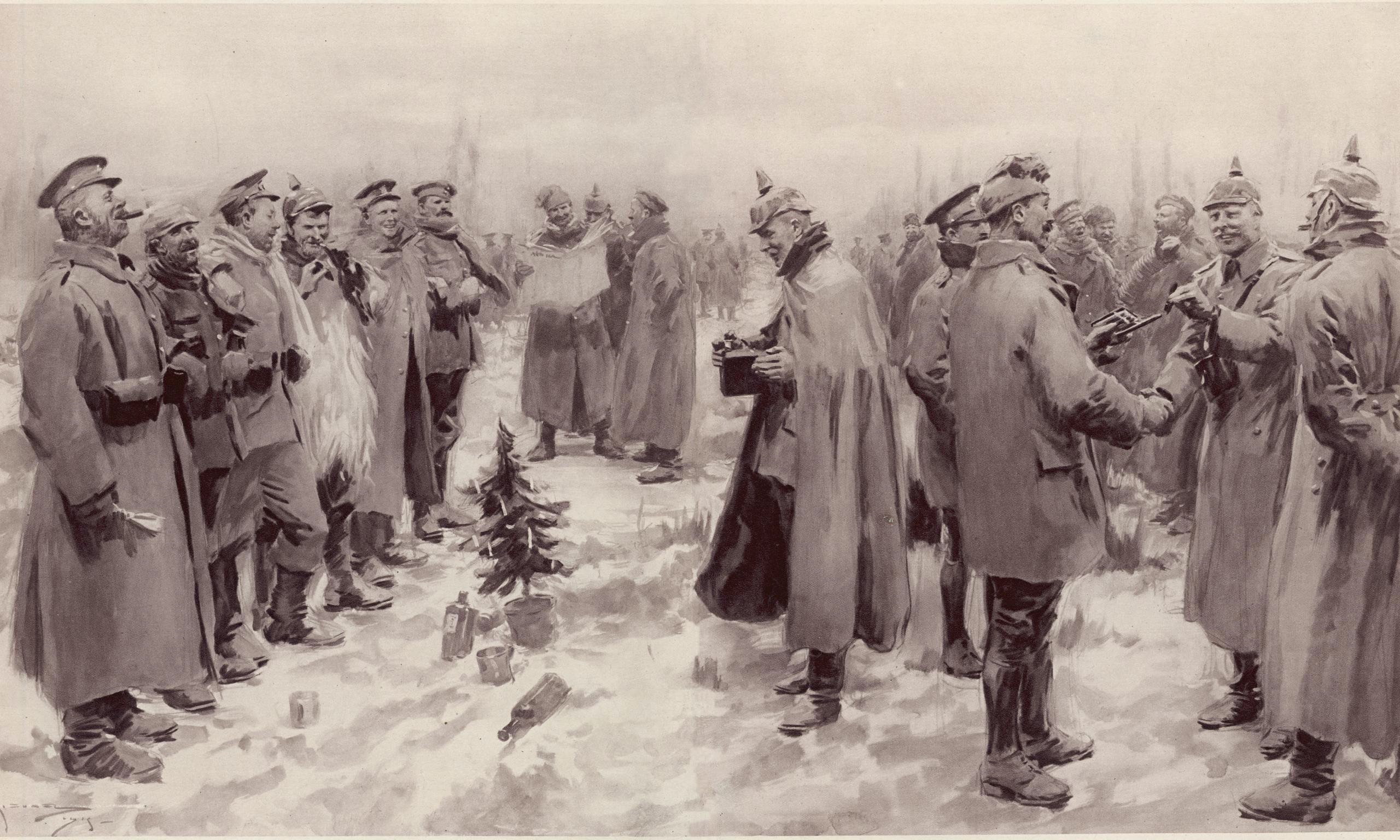
It began in vigil on Christmas Eve. German and British troops started singing carols from their entrenched positions, across the expanse between the armies, each side serenading the other. There was the German rendition of “Silent Night” and the British chorus of “The First Noel.” A brass band was heard. As the first rays of morning sunlight spread over the battlefield, a group of German soldiers rose out of their trenches and stretched the very arc of their lives on the gamble that their counterparts were, despite being British, yet human enough to welcome an honest greeting with humanity and not with bullets: They crossed the “no-man’s land” divide and called out, in their best attempted English, “Merry Christmas.”
Seeing that the Germans were entirely unarmed, and deciding to trust that this was not a trick, Allied soldiers began emerging from their trenches as well. A certain Private Murker accepted a glass of whiskey and reported back that the Germans had said, more or less, “If you don’t shoot us, we won’t shoot you.” World War I is, perhaps, the most confusing of wars — despite its forty million casualties, its raison d’être remains somewhat baffling; it was a war that, by most accounts, did not need to happen. How simple peace can (sometimes) be: “If you don’t shoot us, we won’t shoot you.”
 Eventually, more allied troops emerged. They shook hands with the Germans. Soon gifts were exchanged — cigars and plum pudding and suchlike. A Christmas tree was erected and lit. There was even a friendly soccer match between the opposing sides (one recalls, wistfully, older histories when by mutual consent the length of a war might be curtailed based on the outcome of some miniature, proxy contest). It was a surreal — and yet profoundly real — passage in the two-thousand-year-long story of Christmas.
In medieval Christendom, one of the rules of war was that there be no fighting on holy days (Treuga Dei —the Truce of G0d). Such a constriction is hard for us to understand, but it shows that in those days the totalizing, mechanized views of war had not yet swallowed up our humanity. War was a smaller part of a larger human reality. Despite all the horrors and misery with which man shackles himself, the explosive power of Christ liberates the earth. Humanity’s Redeemer appears between the armies, clothed with a gleaming Joy, which commands our allegiance more forcefully than generals, or armies, or nations. It was in this spirit that the troops of 1914 acted. Is this not a truer “true meaning of Christmas” than our modern, banal distillations?