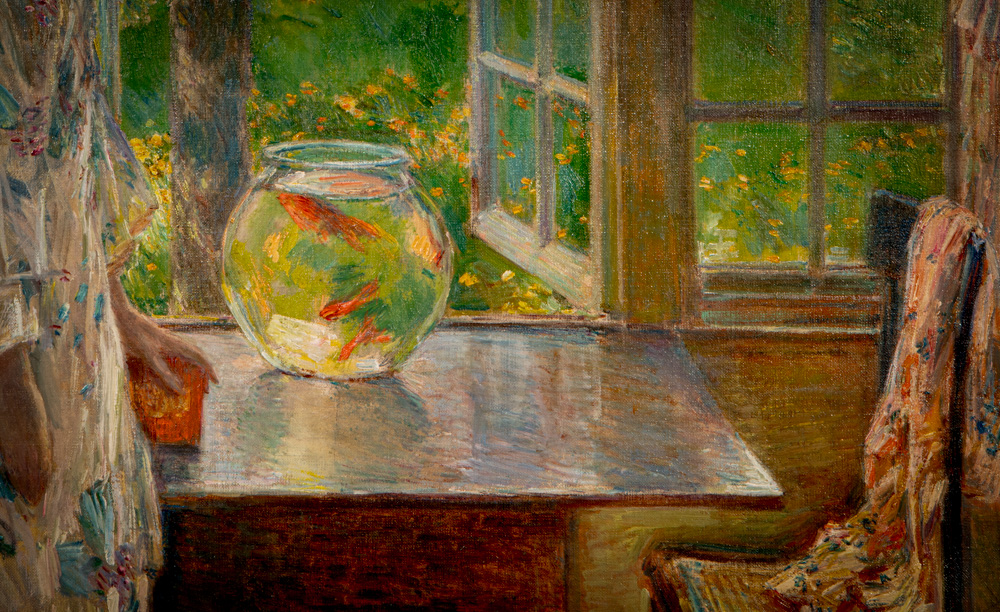



As I thought through what to tell her, I had to face the fact that there was no answer that was both comforting and true: no fish-heaven that God called him home to, no cycle of fish reincarnation giving meaning to his death. Death is part of life. Fish are nasty carnivores and they eat each other. End of story. So I told her that, though as kindly and gently as I could. Then I wrote the fish’s name on a tiny box, slipped the corpse into it, and my daughter and I buried it under a bush in the yard as rain fell on our umbrella.
That was not the end of her grief, however. She followed a long and varied mourning process in the days to come. One night she drew a picture of her deceased fish in the aquarium with the others, “so that he would be remembered.” Then she cried herself to sleep. She would burst into tears when I least expected it and made ritual visits to the grave. “Chickadee is in my memory,” she told me once, after such a visit.
I wanted to help. I wanted to make it easier for her, or perhaps to bring some sense of proportion. The philosophy student in me would have liked to explain further about the contingent nature of material things: “My dear child, Chickadee was a material, composite being and therefore inherently corruptible. Unlike God, his essence is not the same as his existence, but separate from it, and now that his matter has lost its form of fishiness and become instead a corpse, it will break down into its material components.”
But somehow the moment didn’t seem right for introducing my daughter to the philosophical tradition of hylomorphism, beautiful though that tradition is. It seemed more like a moment for a lot of hugging. And so that is what we did: we hugged a lot, she cried in my arms, and I cried too. Because, while mourning a seventeen-cent fish might seem silly, death, destruction — even just change — are inevitable yet abhorrent. And I knew that it wasn’t really the fish she was mourning, or at least not only the fish. As Hopkins writes: “Nor mouth had, no nor mind, expressed / What heart heard of, ghost guessed: / It is the blight man was born for, / It is Margaret you mourn for.”
It is Margaret you mourn for. I didn’t cry for the goldfish — I had lost the ability to cry for pets twenty years earlier when my own beloved pet died. No, I cried for myself, for my daughter, for my husband, for my sons. And I think my daughter did too, whether she understood it or not. We wept for our own mortality. Because, like a goldfish, human life is beautiful — and fragile.
Our immortal spirits, made for the love of a changeless, perfect, eternal God, rage against the limits of our material natures. We rage against death most of all, for death takes from us the ones we love.
But it is not only death we mourn: it is every change that comes to us. Even the best changes, like the healthy growth of a baby, hold an element of tragedy. This is what older people mean when they tell young parents that their adorable but obnoxious toddlers will “grow up too fast.” The particular charms of childhood will be lost in the transition to adulthood, and each year does bring us closer to the grave. So we cling desperately to the present moment, not wishing to part with what we have, fearing that what we receive in exchange will not be as good.
And truly every change cuts us off from what came before, so every change is a small death. It is a reminder that we are exiles, and that this earth, beautiful as it can be, is not our home. “We have not here a lasting city.”
The open grave reminds us that we must seek our lasting city elsewhere. But part of that seeking is continuing to live, continuing to love, continuing to thank God for the beautiful things he has given us. And so Chickadee(deedeedeedee) has been replaced by a black and orange fish, whose flowy tail wafts gracefully behind him as he swims. My daughter thinks he’s pretty, and the other fish have shown no interest in eating him.
Life goes on, every wave and every ripple on its surface bringing us closer to the eternal shore.